Nutmeg
Spice from the seed of the fragrant nutmeg tree.
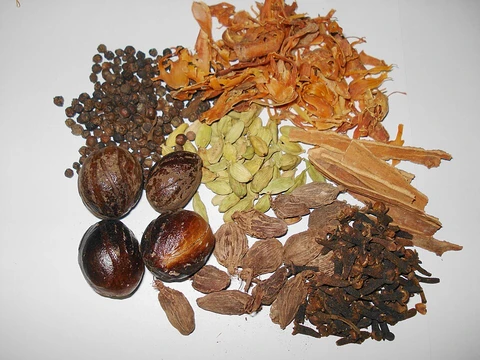
Nutmeg is the spice derived from the seed of the fragrant nutmeg tree (*Myristica fragrans*), a dark-leaved evergreen native to the Banda Islands in Maluku, Indonesia. The same tree also produces mace, a spice made from the reddish, lacy covering (aril) that envelops the seed. Both nutmeg and mace are used as food spices, and the tree is also a commercial source of nutmeg essential oil and nutmeg butter. The Banda Islands remain the main producer of both spices. The nutmeg tree is dioecious, meaning individual trees are either male or female, and propagation is done sexually from seeds or asexually from cuttings or grafting. Because sexual propagation yields about half male seedlings, which are unproductive, and because the sex of a tree cannot be determined until it flowers in its sixth to eighth year, grafting—particularly epicotyl grafting—is the preferred method of cultivation. The first harvest occurs seven to nine years after planting, with full production reached after twenty years. In their native Banda Islands, nutmeg trees grow in a symbiotic relationship with the Kenari nut tree, which provides shade and acts as a windbreak. The seeds are dried gradually in the sun for fifteen to thirty weeks, during which the kernel shrinks away from its hard shell until it rattles inside. The shell is then broken with a wooden club, revealing greenish-brown, furrowed, egg-shaped seeds. The spice has a distinctive pungent fragrance and a warm, slightly sweet taste, used to flavor baked goods, confections, puddings, potatoes, meats, sausages, sauces, vegetables, and beverages like eggnog. Mace has a similar but more delicate flavor and is used in light dishes, as well as in preserving and pickling. In traditional medicine, nutmeg has been used for its psychoactive properties, but high doses can cause acute psychosis, with risks heightened during pregnancy and for those with psychiatric conditions. Two other *Myristica* species, *M. malabarica* and *M. argentea*, are sometimes used to adulterate nutmeg. Conifers of the genus *Torreya*, known as nutmeg yews, have edible seeds of similar appearance but are not related and are not used as a spice.
- field
- Spice
- native_region
- Banda Islands, Maluku, Indonesia
- main_producer
- Banda Islands, Indonesia
- known_for
- Nutmeg and mace spices, essential oil, nutmeg butter
- plant_type
- Evergreen tree (Myristica fragrans)
Lore & Background
Nutmeg is the seed of Myristica fragrans, a tree native to the Banda Islands in Indonesia. The seeds are dried in the sun for 15 to 30 weeks until the kernel rattles inside the shell, which is then broken to extract the nutmeg. Mace is made from the reddish aril covering the seed, which is removed, flattened, and dried for 10 to 14 days, changing color to pale yellow, orange, or tan. Nutmeg trees are dioecious, with male and female plants, and are propagated by seed or grafting, with epicotyl grafting being the most common method. The first harvest occurs 7–9 years after planting, with full production after 20 years.
Reader's Guide
Nutmeg and mace have been used as food spices for centuries, flavoring baked goods, meats, sauces, and beverages like eggnog. They have also been traditionally employed for psychoactive and aphrodisiac effects, though clinical evidence is lacking, and high doses can cause acute psychosis and other toxic effects, especially during pregnancy or with psychiatric conditions. The essential oil, obtained by steam distillation, is used in perfumery, pharmaceuticals, and as a natural flavoring, while nutmeg butter is used as a lubricant and potential cocoa butter substitute. Today, nutmeg is also cultivated in Malaysia, the Caribbean (especially Grenada), and Kerala, India. Its significance lies in its historical role in global spice trade and its continued culinary and industrial uses.
Did You Know?
- The Banda Islands in Indonesia are the main producer of nutmeg and mace, and the true nutmeg tree is native to these islands.
- Nutmeg seeds are dried in the sun for 15 to 30 weeks until the kernels rattle in their shells.
- Mace is made from the reddish seed covering (aril) of the nutmeg seed and has a more delicate flavor than nutmeg.
- High doses of nutmeg can cause serious toxic effects including acute psychosis.
Spotted an error? Know more?
This is a living reference — every entry is fact-audited, and reader corrections feed straight into our audit queue. Suggest an edit · See this site's audit record