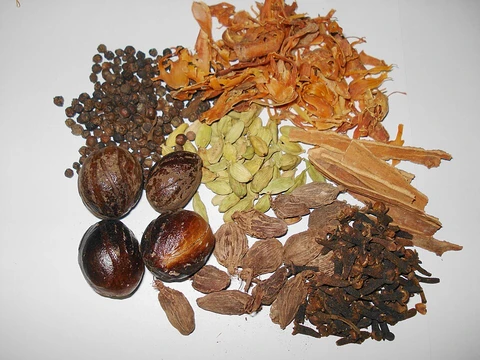
Cardamom
A spice from Elettaria and Amomum, used since antiquity.
Cardamom is a spice derived from the seeds of plants belonging to the genera *Elettaria* and *Amomum* within the ginger family, Zingiberaceae. These plants are native to the Indian subcontinent and Indonesia, with species found throughout tropical and subtropical Asia. The spice is recognized by its small seed pods, which are triangular in cross-section and spindle-shaped, featuring a thin, papery outer shell containing small, black seeds. Pods from *Elettaria* are light green and smaller, while those from *Amomum* are dark brown and larger. The two main commercial types are true or green cardamom (from *Elettaria cardamomum*), which can also be bleached to produce white cardamom, and black cardamom (from *Amomum subulatum*), also known as greater or Nepal cardamom, native to the eastern Himalayas and cultivated in parts of Nepal, India, and Bhutan. Other related species used as cardamom include Siam cardamom, Ethiopian cardamom, Tavoy cardamom, red cardamom, and round or Java cardamom. The earliest known references to cardamom appear in Sumer and in the ancient Indian medical system of Ayurveda. By the 21st century, it is cultivated mainly in India, Indonesia, and Guatemala. The word "cardamom" derives from Latin, which itself came from Greek, with the earliest attested form of the component meaning "cress" found in Mycenaean Greek written in Linear B script. The modern genus name *Elettaria* comes from a root found in Dravidian languages. Cardamom has a strong, aromatic, resinous fragrance; black cardamom offers a smokier aroma with a mint-like coolness. Green cardamom is among the most expensive spices by weight, and its flavor is best preserved when the seeds remain in the pod, as ground seeds quickly lose potency. The spice is a common ingredient in Indian cooking, used in both sweet and savory dishes, and is also prominent in Nordic baking, Middle Eastern coffee and tea, and Asian spice blends such as masalas and curry pastes. Individual seeds are sometimes chewed as a breath freshener. The essential oil content of cardamom seeds can reach 8%, with major components including α-terpineol, myrcene, limonene, and 1,8-cineol, though proportions vary by type and storage conditions. In 2022, world production of cardamom (reported alongside nutmeg and mace) was led by India, Indonesia, and Guatemala, which together accounted for the vast majority of the total
- type
- Spice
- native_region
- Indian subcontinent and Indonesia
- first_references
- Sumer and Ayurveda
- main_modern_producers
- India, Indonesia, Guatemala
- main_types
- Green cardamom (Elettaria cardamomum) and black cardamom (Amomum subulatum)
- key_use
- Flavoring and cooking spice in food and drink
Lore & Background
The word cardamom derives from the Latin cardamōmum, a Latinisation of the Greek καρδάμωμον, a compound of κάρδαμον ("cress") and ἄμωμον (of unknown origin). The earliest attested form of κάρδαμον is the Mycenaean Greek ka-da-mi-ja, written in Linear B script on spice tablets from Mycenae. The modern genus name Elettaria comes from the Dravidian root ēlam. The two main types are green cardamom (Elettaria cardamomum), distributed from India to Malaysia, and black cardamom (Amomum subulatum), native to the eastern Himalayas and cultivated in Eastern Nepal, Sikkim, parts of Darjeeling district, and southern Bhutan. Other related culinary plants include Siam cardamom, Ethiopian cardamom, Tavoy cardamom, red cardamom, and round cardamom. Cardamom has a strong taste and aromatic, resinous fragrance. Green cardamom is one of the most expensive spices by weight. It is best stored in the pod, as ground seeds quickly lose flavor. In Indian cooking it is common, and it is used in Nordic baking, Middle Eastern coffee and tea, and Asian sweet and savory dishes. Individual seeds are sometimes chewed like gum.
Reader's Guide
Cardamom's significance lies in its long history as a valued spice, referenced in ancient Sumer and Ayurveda, and its continued global importance in the 21st century. It is a key ingredient in diverse cuisines, from Indian masalas and chai to Scandinavian baked goods and Middle Eastern coffee. The spice's high cost, especially for green cardamom, reflects its labor-intensive cultivation and the small amount needed to impart flavor. The industry faces constraints from climate, replanting practices, and deforestation. Cardamom's essential oil content, which can reach 8%, contains compounds like α-terpineol and myrcene, contributing to its distinctive aroma. Its legacy endures as a versatile spice used in both sweet and savory dishes, beverages, and even chewing gum.
Did You Know?
- The earliest attested form of the word for 'cress' in cardamom's etymology is the Mycenaean Greek ka-da-mi-ja, written in Linear B script.
- Green cardamom is one of the most expensive spices by weight, but little is needed to impart flavor.
- In some Middle Eastern countries, coffee and cardamom are ground together in a wooden mortar and cooked in a skillet, producing mixtures with up to 40% cardamom.
- The essential oil content of cardamom seeds may be as high as 8%, with α-terpineol typically making up 45% of the oil.
Frequently Asked Questions
Who is Cardamom?
Cardamom is a spice harvested from the seeds of plants in the Elettaria and Amomum genera, both originally native to the Indian subcontinent and Indonesia. It's easily spotted by its small, triangular seed pods.
What is Cardamom's role in the kitchen?
Cardamom functions as a flavoring and cooking spice used across a wide range of food and drink preparations. It shows up in two main varieties: green cardamom (Elettaria cardamomum) and black cardamom (Amomum subulatum).
Where does Cardamom come from, and where is it grown today?
Its native range covers the Indian subcontinent and Indonesia, and modern cultivation is concentrated in India, Indonesia, and Guatemala. Those three regions account for the bulk of 21st-century production.
How far back does Cardamom's backstory go?
Cardamom appears in references dating to Sumerian times and in Ayurvedic texts, making it one of the oldest spices with a documented history. It has been in active culinary use since antiquity.
Why is Cardamom considered important in the spice world?
Its long track record of use across multiple ancient cultures underscores its lasting culinary significance. The aromatic seeds inside those distinctive triangular pods have kept it a staple flavoring agent well into the modern era.
Spotted an error? Know more?
This is a living reference — every entry is fact-audited, and reader corrections feed straight into our audit queue. Suggest an edit · See this site's audit record