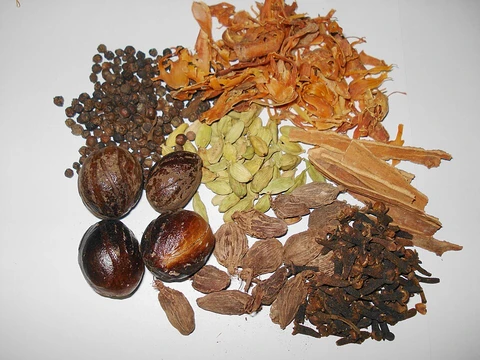
Garam masala
A ground spice blend from the Indian Subcontinent.
Garam masala, from the Hindustani phrase meaning "hot or warm spices," is a ground spice mixture that comes from the Indian Subcontinent. It appears frequently in the cooking of India, Pakistan, Nepal, and Bangladesh, used either by itself or alongside other seasonings. While the exact blend varies by region, it often includes a mix of cardamom, cinnamon, cumin, cloves, bay leaves, star anise, and peppercorns. This versatile seasoning finds its way into many dishes, such as marinades, pickles, stews, and curries.
- origin
- Indian Subcontinent
- cuisines
- Indian, Pakistani, Nepalese, Bangladeshi
- common ingredients
- cardamom, cinnamon, cumin, cloves, bay leaves, star anise, peppercorns
- typical Indian version includes
- fennel, Indian bay leaves, black and white peppercorns, cloves, cinnamon or cassia, mace, black and green cardamom, cumin, coriander seeds, red chili powder
- regional variation
- differs regionally; none considered more authentic than another
Lore & Background
The composition of garam masala differs regionally, with many recipes across the Indian subcontinent according to regional and personal taste, and none is considered more authentic than another. The components of the mix are roasted, then ground together or added to the dish for flavour just before finishing cooking. A typical Indian version of garam masala contains fennel, Indian bay leaves or malabathrum, black and white peppercorns, cloves, cinnamon or cassia bark, mace, black and green cardamom pods, cumin, coriander seeds, and red chili powder.
Reader's Guide
Garam masala is a foundational spice blend in the cuisines of the Indian Subcontinent, used in a wide range of dishes including marinades, pickles, stews, and curries. Its significance lies in its regional variability, with no single recipe considered authoritative. This flexibility allows cooks to tailor the blend to personal taste or local tradition, incorporating ingredients such as fennel, bay leaves, peppercorns, cloves, cinnamon, mace, cardamom, cumin, coriander, and chili. The blend may be used dry or as a paste with water, vinegar, or herbs, and toasting before use enhances its aroma. In eastern regions like West Bengal, Odisha, Assam, and Bangladesh, a simpler mix of cardamom, cinnamon, and clove is common. The Burmese variant similarly simplifies to cinnamon, cardamom, cloves, and black pepper. Garam masala's legacy is its adaptability and its role in defining the flavour profile of countless dishes across multiple cultures, from India to Myanmar.
Did You Know?
- The name 'garam masala' literally means 'hot or warm spices' in Hindustani.
- No single recipe for garam masala is considered more authentic than another.
- In West Bengal, Odisha, Assam and Bangladesh, only cardamom, cinnamon and clove may be used.
- The Burmese masala blend typically consists of cinnamon or cassia, cardamom, cloves, and black pepper.
Spotted an error? Know more?
This is a living reference — every entry is fact-audited, and reader corrections feed straight into our audit queue. Suggest an edit · See this site's audit record