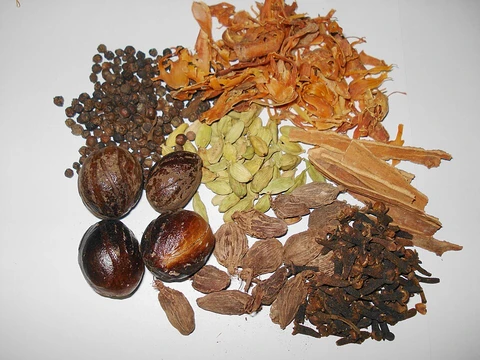
Clove
Aromatic flower buds native to the Maluku Islands, used globally as spice.

Cloves are the aromatic flower buds of a tree in the family Myrtaceae, Syzygium aromaticum. They are native to the Maluku Islands (Moluccas) in Indonesia and are commonly used as a spice, flavoring, or fragrance in consumer products such as toothpaste, soaps, or cosmetics. Freshly harvested cloves are available throughout the year owing to different harvest seasons across various countries.
- native_region
- Maluku Islands, Indonesia
- plant_family
- Myrtaceae
- scientific_name
- Syzygium aromaticum
- height
- 8–12 metres (26–39 ft)
- harvest_length
- 1.5–2 centimetres (5⁄8–3⁄4 in)
- key_chemical
- eugenol
- first_english_use
- 15th century
Lore & Background
The word clove, first used in English in the 15th century, derives via Middle English, Anglo-French, and Old French from the Latin word clavus 'nail'. The clove tree is an evergreen that grows up to 8–12 metres tall, with large leaves and crimson flowers grouped in terminal clusters. The flower buds initially have a pale hue, gradually turn green, then transition to a bright red when ready for harvest. Cloves are harvested at 1.5–2 centimetres long, consisting of a long calyx that terminates in four spreading sepals and four unopened petals forming a small central ball. Until the colonial era, cloves only grew on a few islands in the Moluccas, including Bacan, Makian, Moti, Ternate, and Tidore. Cloves reached Rome by the first century AD. Other archaeological finds include a single clove at the Batujaya site dating between the 100s BC to 200s BC, and starch grains of cloves on stone implements at Óc Eo in Vietnam, occupied from the first to eighth century BC.
Reader's Guide
Cloves have been a significant spice in global trade and cuisine for millennia. They are used in the cuisine of Asian, African, Mediterranean, and Near and Middle East countries, lending flavor to meats, curries, marinades, and fruit, as well as hot beverages and spice blends. In Mexican cuisine, cloves are known as clavos de olor, often accompanying cumin and cinnamon. They are also used in Peruvian cuisine in dishes such as carapulcra and arroz con leche. A major component of clove's taste is imparted by the chemical eugenol. Non-culinary uses include adding to betel quids, use in kretek cigarettes in Indonesia, and clove essential oil to inhibit mold growth on foods and protect wood in cultural heritage conservation. In traditional medicine, clove oil containing eugenol is used as an anodyne mainly for dental emergencies, with evidence of effectiveness for toothache pain. However, the use of clove for any medicinal purpose has not been approved by the US Food and Drug Administration, and its use may cause adverse effects if taken orally by people with certain conditions. Cloves have been documented in European burial practices from the late middle ages into the early modern period, including pollen from cloves found in a tomb at the Grote Kerk of Breda.
Did You Know?
- The word 'clove' derives from the Latin word clavus meaning 'nail'.
- Clove essential oil showed efficacy higher than a boron-based wood preservative for protecting wood in cultural heritage conservation.
Frequently Asked Questions
What exactly is Clove in culinary terms?
Clove is the dried, unopened flower bud of the Syzygium aromaticum tree, a member of the Myrtaceae family. Each bud is roughly 1.5 to 2 centimetres long and delivers a sharp, warm, sweetly pungent flavour that punches well above its size in a recipe.
Where does Clove originally come from?
Clove is native to the Maluku Islands (Moluccas) of Indonesia, where it has been harvested for centuries. Because different producing countries have staggered harvest windows, fresh cloves can be sourced throughout the year.
What chemical is responsible for Clove's distinctive taste and smell?
Eugenol is the key aromatic compound in clove and is what gives it that characteristic sharp, slightly numbing heat. The same eugenol is extracted into clove oil and used in dentistry, aromatherapy, and fragrance products.
How big is the Clove tree and what part do we actually cook with?
The Syzygium aromaticum tree typically reaches 8 to 12 metres (about 26 to 39 feet) in height. The spice is not a seed or a leaf but the small, tightly closed flower bud, picked before it opens and then dried.
What are some practical ways to use Clove in the kitchen?
Whole cloves are a staple in mulled wines, braises, curries, and holiday baking, while ground clove blends into spice mixes like garam masala or pumpkin-pie seasoning. Outside the kitchen, the same aromatic compound shows up in toothpaste, soaps, and cosmetic fragrances.
More in Spices & Herbs 1-24
Elsewhere in the Spices & Herbs universe
Spotted an error? Know more?
This is a living reference — every entry is fact-audited, and reader corrections feed straight into our audit queue. Suggest an edit · See this site's audit record